Managed IT services in Victoria: remote-first support for regional businesses
Managed IT services in Victoria, delivered remote-first: weekday helpdesk, 24/7 SOC monitoring, VPDSS evidence support and no lock-in. Book a free review.
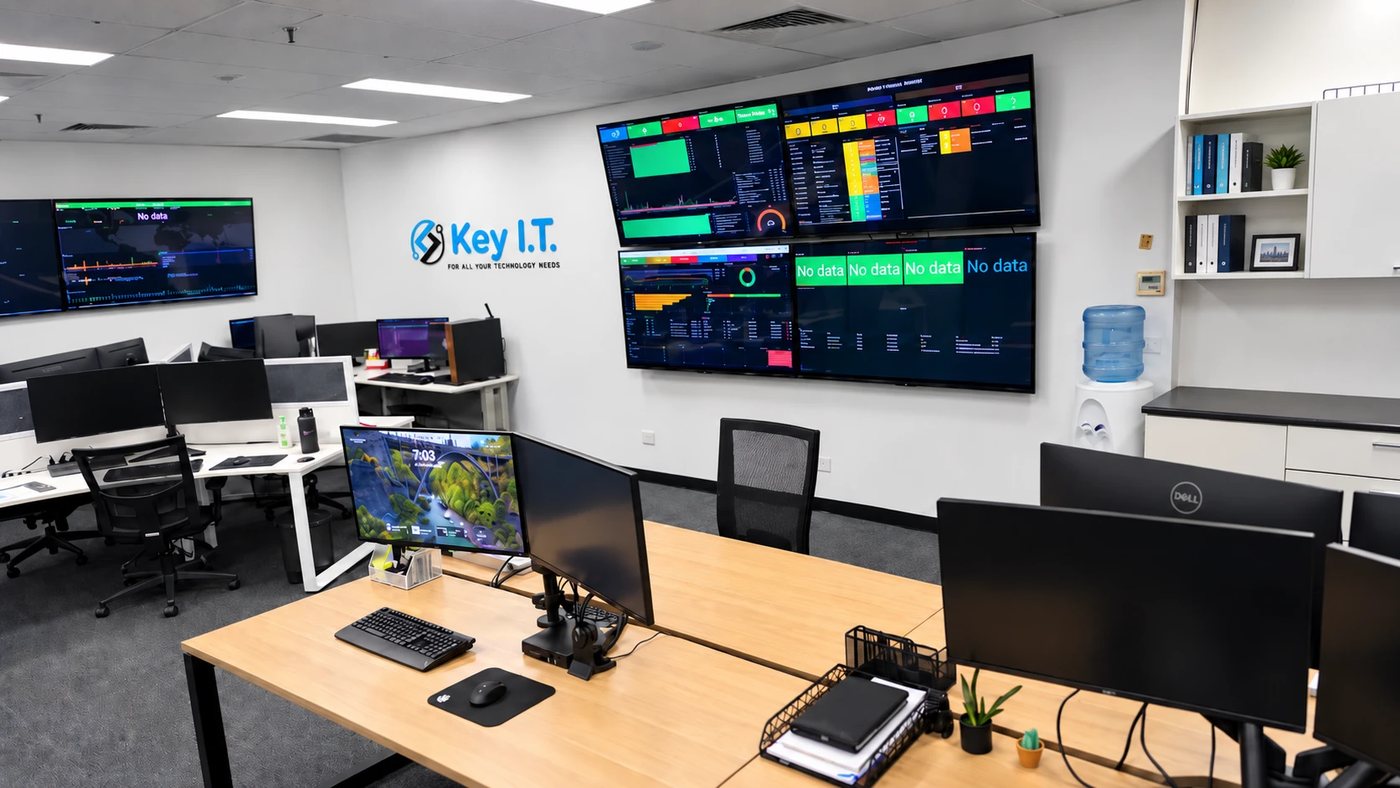
Key IT provides managed IT services across Victoria, not just in Melbourne. Regional businesses get the same helpdesk (Monday to Friday, 8am–5pm), the same security-certified engineers and the same 24/7 SOC monitoring as our city clients. Everyday support runs over secure, logged remote sessions, onsite work is agreed before you sign, and there is no lock-in: our terms run month to month.
Remote-first is a deliberate model, not a consolation prize. Most of what a small business runs on now lives in Microsoft 365, cloud software and laptops that go home every night, so everyday fixes are a secure remote session away. What changes outside Melbourne is hands-on work, and we'd rather say so than pretend an engineer is around the corner.
Do you support businesses outside Melbourne?
Yes, remotely. IT support for regional Victoria, and for interstate businesses, runs through the same helpdesk, tooling and monitoring as our Melbourne service. It suits three situations:
A regional business that has outgrown ad-hoc help and wants security monitoring and Essential Eight hardening alongside everyday support.
A Melbourne business with a regional branch, where the second office deserves the same service as head office.
A team spread across the state that needs one helpdesk and one consistent set of security controls.
Our engineers are based at our head office in Greensborough, north-east Melbourne. Closer in, our Gisborne and Macedon Ranges page shows how this works in practice. Further out, in Geelong, Bendigo, the Latrobe Valley or the Wimmera, the helpdesk, monitoring and patching work exactly the same way.
How does remote-first managed IT work for a regional office?
Remote IT support works the same anywhere in Victoria with a decent internet connection; physical work is planned rather than improvised. A regional client on our managed IT service gets:
A helpdesk you can reach on 1300 053 948, by email or by ticket, Monday to Friday, 8am–5pm. Engineers connect through secure remote support sessions your staff approve, and every session is logged.
Help with urgent problems after hours for managed clients, from whichever engineer is rostered on call.
Security that keeps watching.
Endpoints, Microsoft 365, email and cloud services stay under watch from Key IT's 24/7 SOC service overnight, on weekends and through public holidays.
Onsite by arrangement.
When a job genuinely needs hands, we agree how it will be handled before you sign up.
What gets fixed remotely, and what needs planning?
| Job | How it is handled for a regional office |
|---|---|
| Lockouts, MFA resets, Microsoft 365 and email problems | Remotely, through the helpdesk |
| A suspicious sign-in at 2am on a Sunday | Flagged by 24/7 SOC monitoring and escalated |
| A new starter's laptop | Built and configured before it ships, ready to sign in on day one |
| A failed laptop or desktop | Replacement set up and sent; a pre-built spare kept on site turns a failure into a swap |
| Cabling, a server or an office fit-out | Planned as a project, with onsite work agreed in advance |
Plan for the internet link too. If the whole business runs through one NBN service, a 4G or 5G backup can take over when that line drops. Our business internet page explains failover.
Victorian government contracts and funding: what the VPDSS means for your IT
If your organisation is funded by, or contracted to, a Victorian public sector agency and handles that agency's information, you may be asked to show that you meet the Victorian Protective Data Security Standards (VPDSS).
What is the VPDSS?
The VPDSS are 12 high-level mandatory requirements for protecting Victorian public sector information, spanning governance, information, personnel, ICT and physical security. Version 2.0 was issued on 28 October 2019, according to the Office of the Victorian Information Commissioner (OVIC), which published version 2.4 of its implementation guidance in January 2026.
Do funded agencies and contractors have to comply?
Not directly, but the agency that engages you can require it. OVIC's guidance for contracted service providers says funded agencies and contracted service providers "do not have direct obligations under Part 4" of the Privacy and Data Protection Act 2014 (Vic), yet may need to adhere to the VPDSS if their engaging public sector agency requires it. You don't report compliance to OVIC; the agency decides what assurance it wants from you. And in OVIC's words, "There is no certification process".
How do the standards reach a supplier?
Through the agency. Standard 8, Third Party Arrangements, requires an agency to ensure third parties securely handle public sector information. OVIC's implementation guidance lists what that means on the agency's side: security requirements in contracts matched to the value of the information, a risk assessment of the supplier's service before the arrangement is finalised, assigned security roles, ongoing review, and controls applied when the contract ends. Agencies also submit a Protective Data Security Plan to OVIC every two years and attest annually, according to OVIC's reporting obligations page, so expect searching questions.
What evidence should you have ready?
With no certificate available, assurance rests on evidence. This table maps six standards to records worth keeping current; ask your agency what it actually requires.
| VPDSS standard | What it covers | Evidence to keep ready |
|---|---|---|
| 4: Information Access | Least-privilege access and secure credentials, including two-factor authentication | MFA enforcement report, list of who can reach agency data, leaver checklist |
| 5: Information Security Obligations | Security awareness for everyone with access | Training records and phishing simulation results |
| 6: Information Security Incident Management | A documented incident process with clear roles | An incident response plan naming who tells the agency |
| 7: Information Security Aspects of Business Continuity and Disaster Recovery | Security built into continuity and recovery plans | Backup reports and dated restore tests from your disaster recovery plan |
| 8: Third Party Arrangements | Security across the life of a contract | A list of your own suppliers that touch agency data, and how data is returned or destroyed at contract end |
| 11: ICT Security | Asset management and risk-prioritised vulnerability management, such as patching | Device inventory, patch records and vulnerability scanning reports |
Where does Key IT fit?
Nobody can certify you against the VPDSS, so be wary of anyone who offers to. What an IT provider can do for VPDSS assurance is run the controls and produce the records. Key IT's security-certified engineers enforce MFA, keep devices patched and inventoried, run scans, document your environment and help you answer an agency's security questionnaire with evidence. OVIC's guidance cites the ASD Essential Eight as a primary source for several access and ICT elements, including patching, so that hardening does double duty. For anything contract-specific, ask the agency directly, as OVIC suggests.
Industries we support across Victoria
Obligations follow the industry, not the postcode.
Legal.
Firms hold trust money and confidential files, so one compromised mailbox can become a redirected settlement payment. See IT support for law firms.
Healthcare.
Key IT keeps track of when each clinic's NASH, PRODA and HPOS certificates expire, so a lapsed one doesn't catch the practice out, and we look after dental practices as well as medical clinics. See healthcare IT support.
Not-for-profits.
If you deliver services under a Victorian government funding agreement, reread the VPDSS section above. We also help NFPs claim Microsoft's non-profit licensing. See IT support for not-for-profits.
Getting started remotely
Talk to us.
Request a free IT & Cyber Security Review; a phone or video call is a good place to start.
Agree the scope in writing, including how onsite work will be handled.
Onboard remotely.
We deploy our management and security tooling, document your environment, switch on MFA and bring every device under monitoring.
Hand over cleanly.
Leaving another provider? Our switching checklist covers credentials and documentation.
Frequently asked questions
Do you provide managed IT services in regional Victoria?
Yes, remotely. Regional Victorian clients get the same helpdesk, security tooling and 24/7 SOC monitoring our Melbourne clients use. Account, email, Microsoft 365 and device problems are fixed over secure, logged remote sessions, and how onsite work will be handled is agreed before you sign up.
Will an engineer ever visit our office?
When a job needs hands, yes, by arrangement. Our engineers work from Greensborough, so for regional offices we agree up front how hardware faults, cabling and installations will be handled: a planned visit, a replacement device shipped ready to use, or both.
What are your support hours for regional clients?
Helpdesk hours are the same for every client: Monday to Friday, 8am–5pm Melbourne time. Outside those hours, managed clients ring 1300 053 948 and the rostered on-call engineer handles urgent issues. Security alerts don't wait for business hours either: Key IT's 24/7 SOC service covers nights, weekends and public holidays, wherever your office is.
Can Key IT certify us as VPDSS compliant?
No, and neither can anyone else. OVIC says there is no certification process for funded agencies and contracted service providers; your engaging agency decides what assurance it needs. Key IT can run the controls the standards point to, such as MFA, patching, backups and incident planning, and produce the reports you show the agency.
Do we have to report our VPDSS compliance to OVIC?
Not as a funded agency or contracted service provider. OVIC says you don't report compliance to it; you may instead be asked to demonstrate adherence to the agency that engaged you. That agency reports to OVIC itself, with a Protective Data Security Plan every two years and an annual attestation.
What do managed IT services cost in Victoria?
Most providers charge per user each month. In the Melbourne market the range is roughly $100–$200 per user, and the spread comes down to inclusions like security tools, backup and onsite visits. Key IT's price is a fixed monthly amount per user, set once a free review shows what you need, and our pricing guide breaks down what moves the figure.
Local IT support across Melbourne
Greensborough is home, but our engineers support businesses right across Melbourne. A few of the areas we work in:
IT & cybersecurity services for Melbourne business
Book your free IT & Cyber Security Review
See exactly where your IT and security stand, and what to fix first. No jargon, no obligation.